Fence pickets
20 cedar pickets at 42 in and three 93 in 2×4 rails.
LINEAR STOCK / 1D CUTTING
Pack cut lengths onto the fewest boards or tubes, with kerf, trim, limited stock, repeatable board patterns and a clear offcut for every piece.
Import a parts table as CSV/TSV/TXT (UTF-8, up to 1 MB and 1,000 rows). Review columns, units and quantities before adding rows. Excel: save as CSV or paste cells. PDF drawings and native CAD files are not supported.
Download a sample CSV. Length required; quantity 1–999 (blank = 1). Use a decimal point, fractions, or values with units such as 600 mm. Files stay in this browser. Open project accepts our saved version 1 JSON files (up to 1 MB).
| Name | Length | Qty | Grain | Material | Edge | |
|---|---|---|---|---|---|---|
| Type | Material | Length | Thickness | Qty | Price | |
|---|---|---|---|---|---|---|
Ready. Change any value to redraw.
Waiting for a valid layout.
Layouts are a close approximation of the mathematical optimum. Leave room for saw kerf and trim when you cut, and buy about 10% extra material.
Calculation is unlimited and free. Pay only when you need files with your shop details, customer handoff or CAD outlines (verify units and cutter compensation before machining).
Avery names describe paper sizes only. We are not affiliated with Avery. Print at 100% actual size and test alignment on plain paper.
Quote formula: (materials + edge band + labor) ÷ (1 − margin).
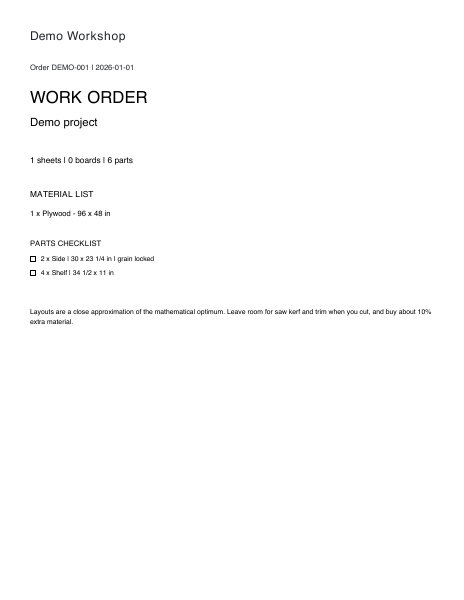
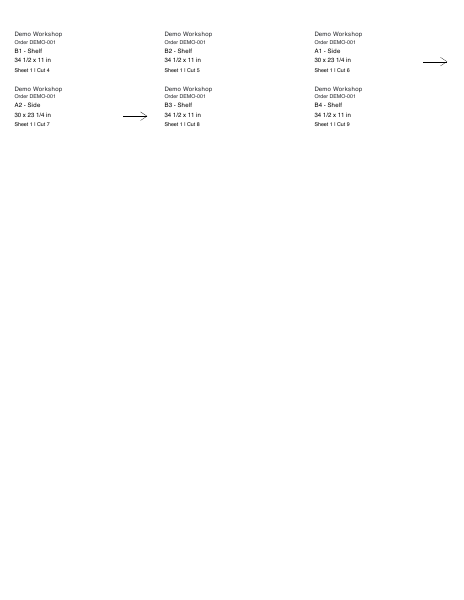
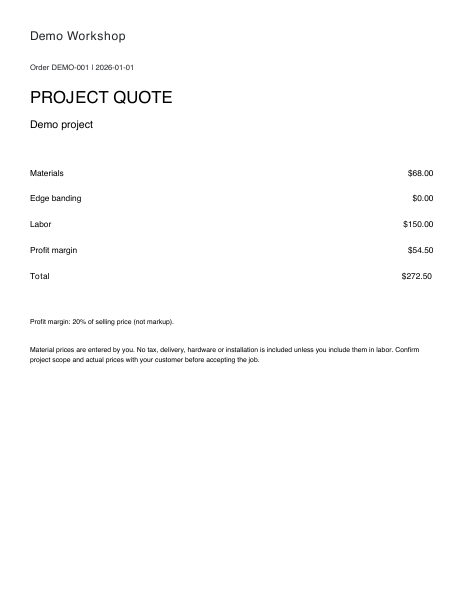
Download the synthetic demo pack. Synthetic sample: Demo Workshop · DEMO-001 · six-part project. Current project: 1 pages · 0 labels · 0 DXF · 0 SVG.
Branding and customer fields are merged in your browser. Only the computed layout data is sent to the selected paid route; the original photo, logo and customer fields never leave this browser.
Each example is a complete, editable project rather than a screenshot. It changes stock, quantities, grain locks and prices so you can see why the optimizer chooses a sheet or board. Select one, then change a dimension and watch the diagram, count and quote update together.
20 cedar pickets at 42 in and three 93 in 2×4 rails.
Studs, plates and braces separated by the same kerf.
Thirty cuts on 8 ft stock: compare zero and 1/8 in kerf.
Long room walls and short returns on 16 ft stock.
1,450 mm cuts on 6 m stock with a 3.2 mm kerf.
For a larger job, import the table from a spreadsheet. The parser recognizes commas, semicolons and tabs, and headers such as name, length, width, qty, grain and material. It accepts mixed numbers like 29-1/4 and decimals like 28.5, then shows the dimensions and quantities for review before adding any rows. Units in headers such as length (mm) override the import unit. Native CAD files and PDF drawings are not parsed.
Use the plywood cut calculator when a supplier offers several sheet sizes and the price comparison matters. Use the linear cut optimizer for studs, hardwood, trim, pipe or tube; it never pretends a one-dimensional board is a sheet. A box built from dimensions belongs in the cabinet calculator, which expands a base, wall or tall cabinet into sides, bottoms, stretchers, shelves and an applied back. If the project starts with rough lumber, the board foot calculator gives a purchase estimate before you make the cut list.
The two guides answer the recurring shop questions: plywood sheet sizes keeps nominal and actual measurements separate, while table saw kerf explains why a blade width belongs in the plan. These pages link back here with their calculated examples, so a reader can move from a dimension question to a working layout without retyping the project.
A board with lengths 60 and 24 in and a 1/8 in kerf uses 84 1/8 in. The final cut is not charged after a part that ends exactly at the stock end, so the engine checks every pattern against length − trim and kerf × (parts − 1).
Linear stock is one-dimensional: each cut only consumes length. The sheet engine uses a guillotine layout with grain-aware rotation, while the board engine searches exact small patterns before using randomized first-fit for larger lists.
Yes. Give each linear stock row its own material name and length. The result groups the pieces by material, so 2×4 studs and 6 m steel tube do not compete for the same board.
A number in Stock quantity is a hard cap. A blank quantity means buy as needed. If the cap is too small, the result lists the unplaced cuts and keeps the successful board plans visible.
Print the PDF at 100% actual size with fit-to-page disabled. Test the alignment on plain paper before loading Avery 5160, Avery 5163 or A4 L7160 sheets.
Calculations, CSV imports and project files stay on this device. A paid export sends only computed layout data to the server; shop details, logos, customers and order numbers are added in this browser.
These tools share the same unit handling, local project files, grain and kerf rules, and free diagram output. Choose the page that matches the material you are buying: